


Welcome to the Brown History Newsletter. If you’re enjoying this labor of love, please do consider becoming a paid subscriber. Your contribution would help pay the writers and illustrators and support this weekly publication. If you like to submit a writing piece, please send me a pitch by email at brownhistory1947@gmail.com.
Don’t forget to check out our SHOP and our Podcast.

Recommended Reads:


How Pakistan’s Military Became Its Most Powerful Institution
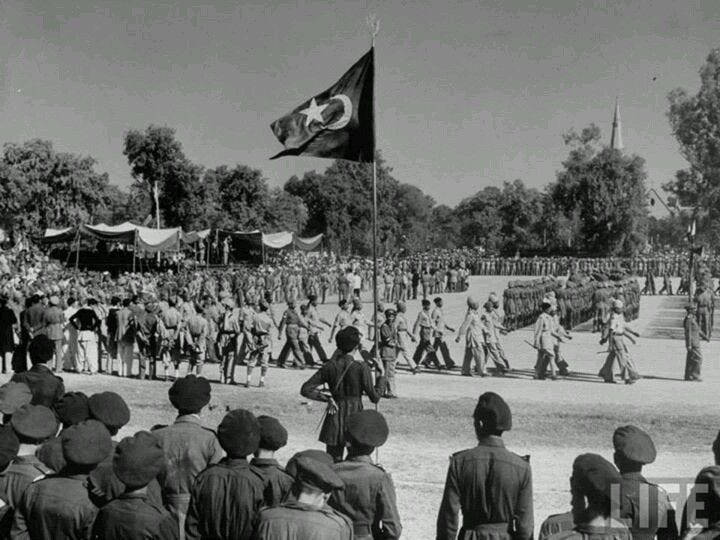
“Do not forget that the armed forces are the servants of the people. You do not make national policy; it is we, the civilians, who decide these issues, and it is your duty to carry out these tasks with which you are entrusted.”
― Muhammad Ali Jinnah
The founder of Pakistan’s plea was both a promise and an instruction, a guide for a country born out of fire. Yet within a decade, the new state looked less like Jinnah’s hope and more like his paradox. A republic imagined under civilian hands found its strongest and safest institution already draped in uniform. Jinnah's early speeches were woven with the ideals of democratic governance and civilian supremacy, a call for the army to serve, not command.
Military dictatorship in Pakistan refers to periods when generals overthrew elected governments, suspended constitutions, and ruled directly. They often justified their actions as necessary to save the country from chaos. Since independence in 1947, the military has governed Pakistan for more than half of its history.